
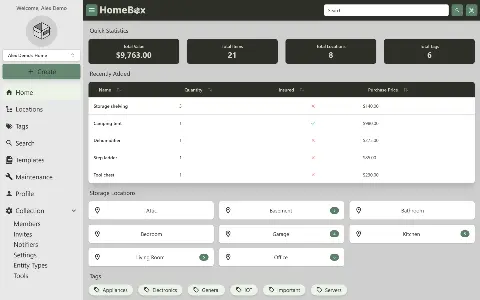
Homebox Home & family· Instead of Spreadsheets
A home inventory app: items, locations, receipts, warranties, QR labels.

The open alternative to Google Photos: automatic backup, search by faces and places, shared albums.
Immich backs up the photos and videos from your phone and camera automatically, sorts them by date and place and makes them searchable — including by what is in the picture.
Share albums with others, see where your photos were taken on a map, and let the iOS and Android apps upload new shots in the background. In short: Google Photos, except it belongs to you.
 Automatic backup from your phone, also in the background Search by people, places and what is in the picture Albums and share links for family and friends Map, memories and timeline the way you know them
Good to know before the first start. The first visit creates the admin account. Faces, places and content search are handled by a separate recognition service inside your pod — it needs most of the memory and is the reason for the larger defaults.
Also instead of iCloud Photos, Amazon Photos, Flickr.
Your photos live in your own instance, not in someone else’s account Face recognition and search run on your side, not elsewhere You decide how much storage you book| Google Photos and Podless | Google Photos | On Podless |
|---|---|---|
| Where the data lives | Google PhotosOn the provider’s servers | On PodlessIn your own instance in the EU |
| Source code | Google PhotosNot open to read | On PodlessOpen, you can read what runs |
| Ads and profiling | Google PhotosPer the provider’s terms | On PodlessNone |
| Your own domain | Google PhotosUsually not offered | On PodlessIncluded, certificate too |
| Getting out again | Google PhotosAs far as the provider allows | On PodlessSFTP, database, backups to your storage |
| If it gets shut down | Google PhotosYou have to move | On PodlessYou decide when you leave |
At the recommended size (2 cores · 8 GB RAM · 50 GB Storage) about €8.80 a month, billed by the hour. Stop Immich and you only pay for storage.
No. No server, no Docker, no terminal commands. You click start and Immich runs. Updates are tested on our own instances first and then rolled out.
In your own Immich instance on servers in Germany and France; bulk storage sits in Frankfurt. Add your own S3 bucket and we back up there daily, encrypted.
Immich is open source and keeps running on your own server. You fetch the files over a time-limited SFTP access and reach the database with the credentials from the dashboard.
A home inventory app: items, locations, receipts, warranties, QR labels.
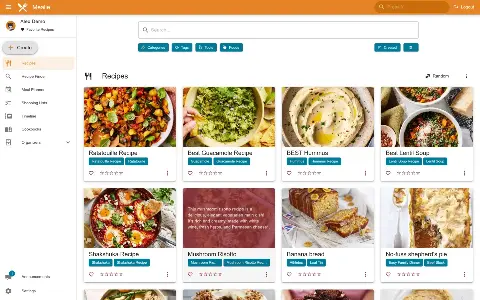

A recipe app for the household: collect, plan the week, generate the shopping list.
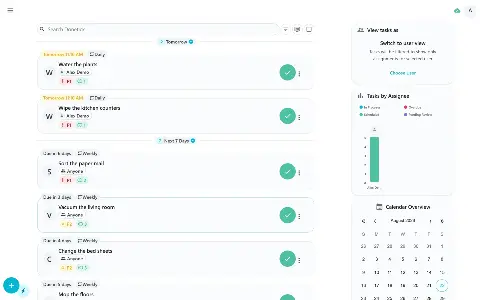

A chore chart for flatmates and families: recurring tasks, fairly shared.